chess pieces - satranç taşlarının İngilizce Türkçe İsimleri
chess pieces - satranç taşları
King-Şah(Kral)
Rook-Kale
Bishop-Fil
Pawn-Piyon
Knight-At
Queen- Vezir
Sacrifice-Feda
Check-Şah çekmek
stalemate-pat
castling-rok çekmek
promote-terfi ettirmek
en pessant - geçer piyon
opening-açılış
capture-taşı kırmak
threat - tehdit etmek
advance - sürmek
move- hamle
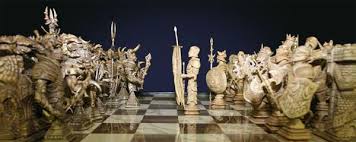
Origins of chess
Many countries claim to have invented the chess game in some
incipient form. The most commonly held belief is that chess originated
in India, where it was called Chaturanga, which appears to have been
invented in the 6th century AD. Although this is commonly believed, it
is thought that Persians created a more modern version of the game after
the Indians. In fact, the oldest known chess pieces have been found in
excavations of ancient Persian territories.
Another theory exists that chess arose from the similar game of
Chinese chess, or at least a predecessor thereof, existing in China
since the 2nd century BC. Joseph Needham and David Li are two of many
scholars who have favored this theory.
Chess eventually spread westward to Europe and eastward as far as
Japan, spawning variants as it went. One theory suggests that it
migrated from India to Persia, where its terminology was translated into
Persian, and its name changed to chatrang. The entrance of chess into
Europe, notably, is marked by a massive improvement in the powers of the
queen. The oldest known texts describing chess seem to indicate a
bi-directional spread from the Persian empire. In fact, the oldest known
reference points to Shah Ardashir as being a master of the game, his
rule was from 224 – 241 AD. This would indicate that chess was invented
some time before his rule.
From Persia it entered the Islamic world, where the names of its
pieces largely remained in their Persian forms in early Islamic times.
Its name became shatranj, which continued in Spanish as ajedrez and in
Greek as zatrikion, but in most of Europe was replaced by versions of
the Persian word shah = “king”.
There is a theory that this name replacement happened because,
before the game of chess came to Europe, merchants coming to Europe
brought ornamental chess kings as curiosities and with them their name
shah, which Europeans mispronounced in various ways.
* Checkmate: This is the English rendition of shah mat, which is Persian for “the king is finished”.
* Rook: From the Persian rukh, which means “chariot”,
but also means “cheek” (part of the face). The piece resembles a siege
tower. It is also believed that it was named after the mythical Persian
bird of great power called the roc. In India, the piece is more
popularly called haathi, which means “elephant”.
* Bishop. From the Persian pil means “the elephant”,
but in Europe and the western part of the Islamic world people knew
little or nothing about elephants, and the name of the chessman entered
Western Europe as Latin alfinus and similar, a word with no other
meaning (in Spanish, for example, it evolved to the name “alfil”). This
word “alfil” is actually the Arabic for “elephant” hence the Spanish
word would most certainly have been taken from the Islamic provinces of
Spain. The English name “bishop” is a rename inspired by the
conventional shape of the piece. In Russia, the piece is, however, known
as “elephant”. In the Indian lingo however, the piece is more popularly
known as oont = “camel”.
* Queen. Persian farzin = “vizier” became Arabic
firzan, which entered western European languages as forms such as
alfferza, fers, etc but was later replaced by “queen”. Incidentally, the
Indian equivalent of “queen”, rani is used for the piece by Indians.
The game spread throughout the Islamic world after the Muslim
conquest of Persia. Chess eventually reached Russia via Mongolia, where
it was played at the beginning of the 7th century. It was introduced
into Spain by the Moors in the 10th century, and described in a famous
13th century manuscript covering chess, backgammon, and dice named the
Libro de los juegos. Chess also found its way across Siberia into
Alaska.
Modern chess
Early on, the pieces in European chess had limited movement;
bishops could only move by jumping exactly two spaces diagonally
(similar to the elephant in xiangqi), the queen could move only one
space diagonally, pawns could not move two spaces on their first move,
and there was no castling. By the end of the 15th century, the modern
rules for the basic moves had been adopted from Italy: pawns gained the
option of moving two squares on their first move and the en passant
capture therewith, bishops acquired their modern move, and the queen was
made the most powerful piece; consequently modern chess was referred to
as “Queen’s Chess” or “Mad Queen Chess”. The game in Europe since that
time has been almost the same as is played today. The current rules were
finalized in the early 19th century, except for the exact conditions
for a draw.
The most popular piece design, the “Staunton” set, was created by
Nathaniel Cook in 1849, endorsed by Howard Staunton, a leading player of
the time, and officially adopted by Fédération Internationale des
Échecs (FIDE) in 1924.
Chess’s international governing body is FIDE, which has presided
over the world championship matches for decades. Most countries of the
world have a national chess organization as well. Although chess is not
an Olympic sport, it has its own Olympiad, held every two years as a
team event.
whatingilizce.blogspot.com
IRMIZI BAŞLIKLI KIZ MASALI İNGİLİZCE ÖZETİ Kırmızı Başlıklı Kızın İngilizce Özeti The story is about a lovely sweet girl who is loved by o...
.jpg)
-
Personal info Name: Neymar Age: 21 years (5 February 1992) Stature: 174 cm Weight: 65 kg Nationalit...
-
Lawyer (Avukat): A lawyer is a person who has studied the law and is an expert in the way their country’s rules and government work. A l...

.jpg)